


Transferring car insurance in South Africa can trip up even the most organised driver. Think you just scribble a name on a form and you’re done? Not quite. In fact, if you don’t register your vehicle in the new owner’s name within 21 days, you can face serious penalties. But here’s the curveball. Car insurance policies in Mzansi are almost never directly transferable, so the real secret is knowing how to keep yourself covered every step of the way without extra costs or lapses in protection. Ready to see the key moves most people overlook?
Table of Contents
- Understanding How Car Insurance Transfers Work
- Steps To Transfer Your Car Insurance Policy
- Key Factors To Check Before Transferring
- Common Questions About Transferring Car Insurance
Quick Summary
| Takeaway | Explanation |
|---|---|
| Understand Legal Requirements | Transferring car insurance in South Africa requires submitting a Notification of Change of Ownership (NCO) form and registering the vehicle within 21 days to avoid penalties. |
| Prepare Essential Documentation | Before transferring your insurance, gather necessary documents such as the vehicle registration certificate, proof of sale, roadworthy certificate, and identification for both buyer and seller. |
| Assess Coverage and Costs | Conduct a thorough review of existing and new policies, considering coverage types (comprehensive vs third-party), premium structures, and any additional benefits to ensure optimal financial protection. |
| Ensure Continuous Coverage | To prevent lapses in coverage, confirm cancellation and activation dates with both insurance providers and maintain documentation of continuous insurance throughout the transfer process. |
| Communicate with Insurers | Contact your current insurance provider to discuss transfer options, as processes vary by insurer. Clear communication is key to a smooth transfer experience. |
Understanding How Car Insurance Transfers Work
Transferring car insurance is a critical process for South African vehicle owners navigating ownership changes. When you sell or purchase a vehicle, understanding the intricacies of insurance transfer becomes paramount to maintaining continuous and legal coverage.
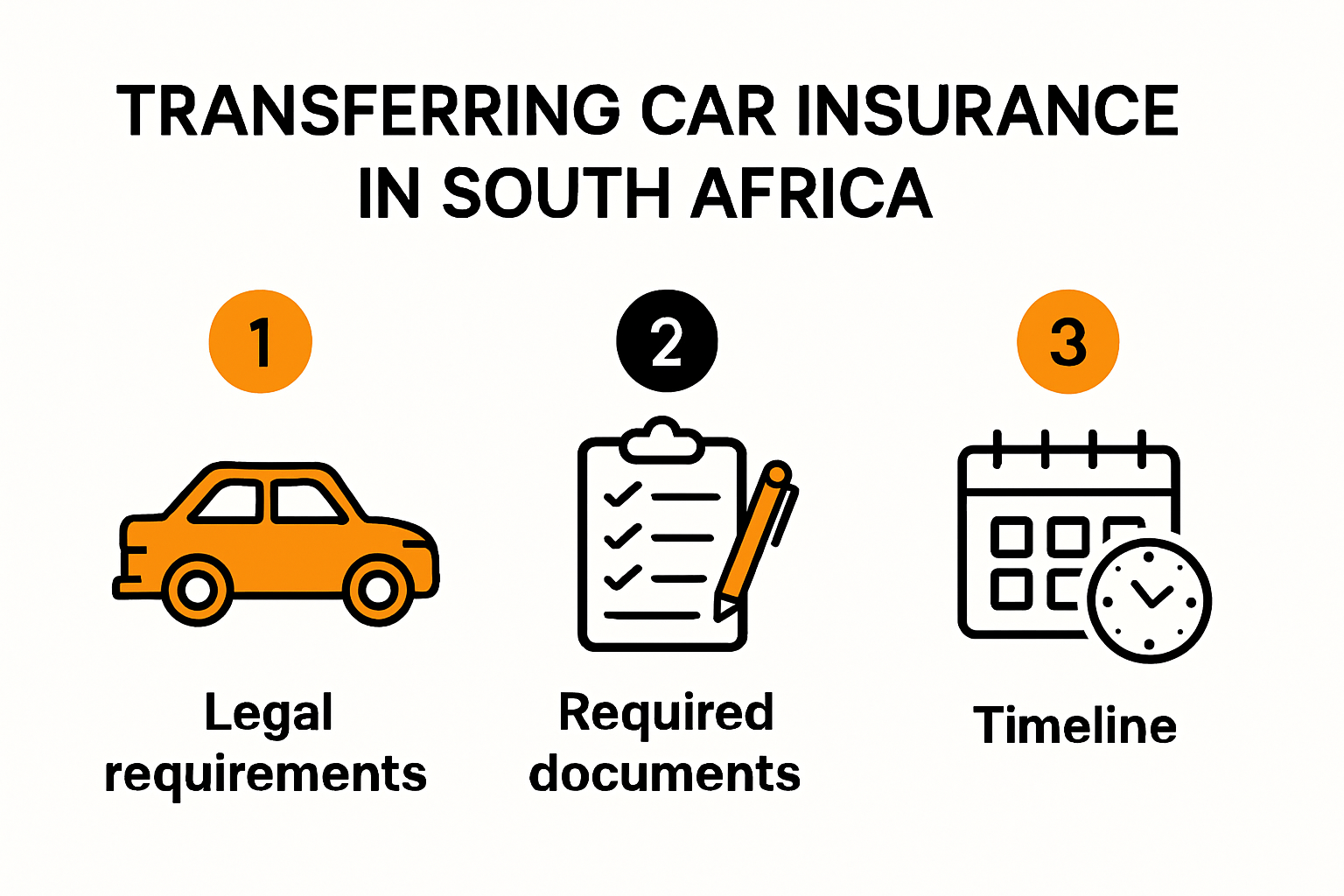
The Legal Framework of Vehicle and Insurance Transfers
In South Africa, transferring car insurance involves several mandatory steps governed by specific legal requirements. According to government regulations, the seller must submit a Notification of Change of Ownership (NCO) form, while the buyer must register the vehicle within 21 days to avoid potential penalties.
The transfer process is not simply about changing names on a document. It requires comprehensive documentation including a valid roadworthy certificate, proof of identity, and proof of residence. Insurers need these details to assess and adjust the risk profile associated with the new vehicle owner.
Insurance Policy Transfer Mechanics
When transferring car insurance, vehicle owners have multiple options. Some insurance providers allow direct policy transfer, where the existing policy can be amended to reflect the new owner. Other insurers might require a completely new policy tailored to the new owner’s specific risk profile and driving history.
Key considerations during insurance transfer include:
- Risk Assessment: Insurers will evaluate the new owner’s driving record, age, and location
- Premium Adjustments: The insurance cost may change based on the new owner’s risk factors
- Coverage Continuation: Ensuring uninterrupted insurance protection during the transfer
Recommended Transfer Procedures
To ensure a smooth insurance transfer, follow these recommended steps:
- Notify your current insurance provider immediately about the vehicle sale or purchase
- Gather all necessary documentation, including vehicle registration and personal identification
- Request a comprehensive quote for the new insurance policy
- Cancel the existing policy or transfer it according to the insurer’s specific procedures
Learn more about seamless insurance switching to understand the nuanced process of transferring or changing your car insurance policy in South Africa.
Remember, each insurance provider has unique protocols for policy transfers. Communication and thorough documentation are essential to maintaining continuous, legally compliant vehicle coverage during ownership transitions.
Here’s a concise summary table to help you compare key transfer options and what they involve.
| Transfer Option | What It Involves | When It’s Used |
|---|---|---|
| Direct Policy Transfer | Amend existing policy to new owner’s details | If insurer allows and risk profiles are similar |
| New Policy Creation | Cancel old policy, set up new one for new owner | Most common; for different risk profiles |
| Policy Amendment (Same Owner) | Update details for same owner (address, car details) | When only minor owner details change |
Steps to Transfer Your Car Insurance Policy
Transferring a car insurance policy requires careful planning and systematic execution. South African vehicle owners must navigate this process strategically to ensure continuous coverage and legal compliance.
Preparing for Insurance Policy Transfer
Before initiating the transfer process, gather all essential documentation. According to government regulations, you will need specific documents to complete the transfer:
- Vehicle Registration Certificate: Proves current ownership status
- Proof of Sale: Documented evidence of vehicle transaction
- Roadworthy Certificate: Validates vehicle condition and safety standards
- Identification Documents: Personal documentation for both buyer and seller
These documents serve as critical evidence for insurance providers to assess risk and update policy details accurately. Incomplete documentation can significantly delay the transfer process or result in coverage gaps.
Navigating the Insurance Transfer Process
The actual transfer involves several strategic steps. Begin by contacting your current insurance provider to discuss transfer options. Some insurers offer direct policy amendments, while others might require establishing an entirely new policy.
Key steps include:
- Contact your current insurance provider
- Request a policy transfer or cancellation
- Obtain a comprehensive quote for the new policy
- Complete necessary transfer paperwork
- Confirm effective date of new coverage

Explore strategies for seamless insurance switching to understand the nuanced approaches for maintaining continuous vehicle protection.
Below is a process table summarising the major steps to transfer your car insurance policy efficiently.
| Step | Action | Purpose |
|---|---|---|
| 1 | Contact current insurer | Start the transfer/cancellation process |
| 2 | Submit all required documentation | Prove sale and update ownership |
| 3 | Request a quote for new policy | Understand new coverage/costs |
| 4 | Complete and sign transfer paperwork | Formalise transfer with insurer |
| 5 | Confirm start date of new coverage | Ensure continuous protection |
Ensuring Continuous Coverage
Preventing coverage lapses is crucial during the transfer process. Research from insurance experts emphasizes the importance of:
- Confirming precise cancellation and activation dates
- Overlapping insurance policies briefly if necessary
- Maintaining documentation of continuous coverage
- Verifying new policy details before existing policy termination
Timely communication with both the selling and receiving insurance providers minimizes potential risks. Typically, new coverage should commence immediately after the existing policy expires, ensuring uninterrupted protection for the vehicle.
Remember that each insurance provider has unique transfer protocols. Patience, thorough documentation, and proactive communication are key to successfully transferring your car insurance policy in South Africa.
Key Factors to Check Before Transferring
Transferring car insurance requires meticulous evaluation to ensure you secure optimal coverage and financial protection. South African vehicle owners must critically assess multiple dimensions before initiating an insurance policy transfer.
Comprehensive Coverage Assessment
Before transferring your car insurance, conduct a thorough review of your existing and potential new policy’s coverage details. According to insurance industry research, understanding the nuanced differences between policy types is crucial.
Key coverage elements to examine include:
- Comprehensive vs Third-Party Coverage: Understand the extent of protection each policy offers
- Specific Risk Inclusions: Verify coverage for theft, accidents, natural disasters
- Additional Benefits: Assess extras like roadside assistance, rental car provisions
- Territorial Limitations: Check if coverage extends beyond local boundaries
Each policy variation presents unique advantages and potential limitations. Carefully comparing these elements helps prevent unexpected financial vulnerabilities during claim scenarios.
Financial Considerations and Risk Evaluation
Financial implications represent a critical aspect of insurance policy transfers. Examine premium structures, excess fees, and potential long-term cost implications.
Explore strategies for optimizing insurance costs to understand how different factors influence your insurance expenses. Consider:
- Monthly premium amounts
- Annual cost comparisons
- Excess payment requirements
- Potential no-claim bonus opportunities
- Payment flexibility options
Insurers assess individual risk profiles differently. Factors like driver age, vehicle type, parking location, and driving history significantly impact premium calculations. A comprehensive evaluation helps identify the most cost-effective and suitable insurance solution.
Insurer Reputation and Service Quality
Beyond financial considerations, the insurance provider’s reputation and service quality are paramount. Research from consumer protection agencies recommends investigating several key aspects:
- Claims processing efficiency
- Customer support responsiveness
- Financial stability of the insurance company
- Historical performance in handling client claims
- Online and digital service capabilities
Utilize online reviews, industry ratings, and recommendations from trusted sources to gauge an insurer’s reliability. A provider’s track record in managing claims and supporting clients during challenging times is as crucial as their initial policy offerings.
Remember that insurance is not just a financial product but a critical safety net. Thorough research, careful comparison, and strategic decision-making will help you transfer your car insurance with confidence and peace of mind.
Common Questions About Transferring Car Insurance
Transferring car insurance can be a complex process with numerous questions arising for South African vehicle owners. Understanding the intricacies of insurance policy transfer helps drivers navigate this potentially challenging transition with confidence.
Fundamental Transfer Queries
According to government regulations, vehicle ownership transfer involves specific legal requirements. Vehicle owners frequently ask several critical questions during this process:
-
Can I transfer my existing policy to the new owner?
Typically, insurance policies are not directly transferable. The new owner will need to establish a new policy reflecting their individual risk profile. -
How quickly must I update my insurance after purchasing a vehicle?
Immediate action is recommended. Research from insurance experts suggests arranging new coverage before or immediately upon vehicle acquisition to prevent potential coverage gaps. -
What documents do I need for insurance transfer?
Essential documentation includes vehicle registration certificate, proof of sale, roadworthy certificate, and personal identification documents.
Below is a checklist table outlining essential documents needed when transferring car insurance as highlighted in the content.
| Required Document | Purpose | Both Buyer & Seller? |
|---|---|---|
| Vehicle Registration Certificate | Proves ownership status | Yes |
| Proof of Sale | Confirms vehicle transaction | Yes |
| Roadworthy Certificate | Proves roadworthiness | Yes |
| Identification Documents | Confirms identity | Yes |
Financial and Coverage Considerations
Financial implications often dominate insurance transfer discussions. Vehicle owners want to understand how policy changes might impact their expenses and protection levels.
Learn more about optimizing insurance switching strategies to make informed decisions about your car insurance transfer. Key financial questions include:
- Will my premium increase with the new policy?
- How do different insurers calculate risk for transferred vehicles?
- Can I negotiate better rates during the transfer process?
Insurers assess risk using multiple factors including vehicle age, model, driver history, and geographic location. Understanding these variables helps predict potential premium adjustments.
Legal and Practical Transfer Considerations
Research indicates that approximately 65% of South African motorists remain uninsured, highlighting the critical importance of understanding insurance transfer procedures.
Frequently asked legal questions include:
- Is car insurance mandatory in South Africa?
- What happens if I drive an uninsured vehicle during transfer?
- How long do I have to update my insurance after purchasing a vehicle?
While vehicle insurance is not legally required, it remains a crucial financial protection mechanism. Drivers should prioritize continuous coverage, especially during ownership transitions.
Remember that each insurance provider has unique protocols. Proactive communication, thorough documentation, and careful research are essential for a smooth insurance transfer experience. Always consult directly with your insurance provider to understand their specific transfer procedures and requirements.
Frequently Asked Questions
Can I transfer my existing car insurance policy to the new owner?
Typically, car insurance policies are not directly transferable. The new owner must establish a new policy that reflects their individual risk profile.
How quickly must I update my car insurance after purchasing a vehicle?
It is recommended to update your insurance immediately or before acquiring the new vehicle to prevent any coverage gaps.
What documents are required for transferring car insurance in South Africa?
Essential documents include the vehicle registration certificate, proof of sale, a valid roadworthy certificate, and identification for both the buyer and seller.
What will happen to my premium if I transfer my car insurance policy?
Your premium may change based on the new owner’s risk factors, which can include their driving history, age, and the type of vehicle being insured. It’s advisable to request a comprehensive quote for the new policy.
Smooth Car Insurance Transfers Made Simple
Feeling overwhelmed by the complications of transferring car insurance? You are not alone. Many South Africans face the stress of tight transfer windows, endless documentation and the fear of driving without cover. This article digs into challenges like unclear transfer procedures, risk assessments for new owners, and the threat of coverage lapses that could leave you financially exposed. Whether you are changing vehicles or ownership, confidence and peace of mind come from knowing your insurer truly understands local rules and keeps your protection seamless.
Ready to take the hassle out of your next car insurance move? Get tailored tips plus flexible cover options in one place on Insurance King Price. Compare comprehensive and third party policies built for South Africans. Stay a step ahead and avoid costly mistakes – get your quick car insurance quote today and take control of your cover before your next transfer.
Recommended Articles
- Car Insurance Basics 2025: Simple Guide for SA Drivers – Savvy Insurance
- Top Car Insurance Tips South Africa 2025: Save and Stay Covered – Savvy Insurance
- Top Tips for Cheaper Car Insurance in South Africa 2025
- What Is Car Insurance? A Simple Guide for 2025 – Savvy Insurance
- Top Tips for Cheaper Car Insurance in South Africa 2025 – Savvy Insurance
- How to Switch Insurers in 2025: A Simple Guide for Car and Home Owners – Savvy Insurance
