

Did you know that over 30 percent of insurance claims in South Africa get delayed or rejected due to missing paperwork or process errors? Filing a claim can feel overwhelming, especially when your finances or property are at stake. Understanding every step gives you more control and helps you avoid frustrating setbacks. Clear guidance on handling your claim from start to finish can mean the difference between a swift payout and months of waiting.
Quick Summary
| Key Point | Explanation |
|---|---|
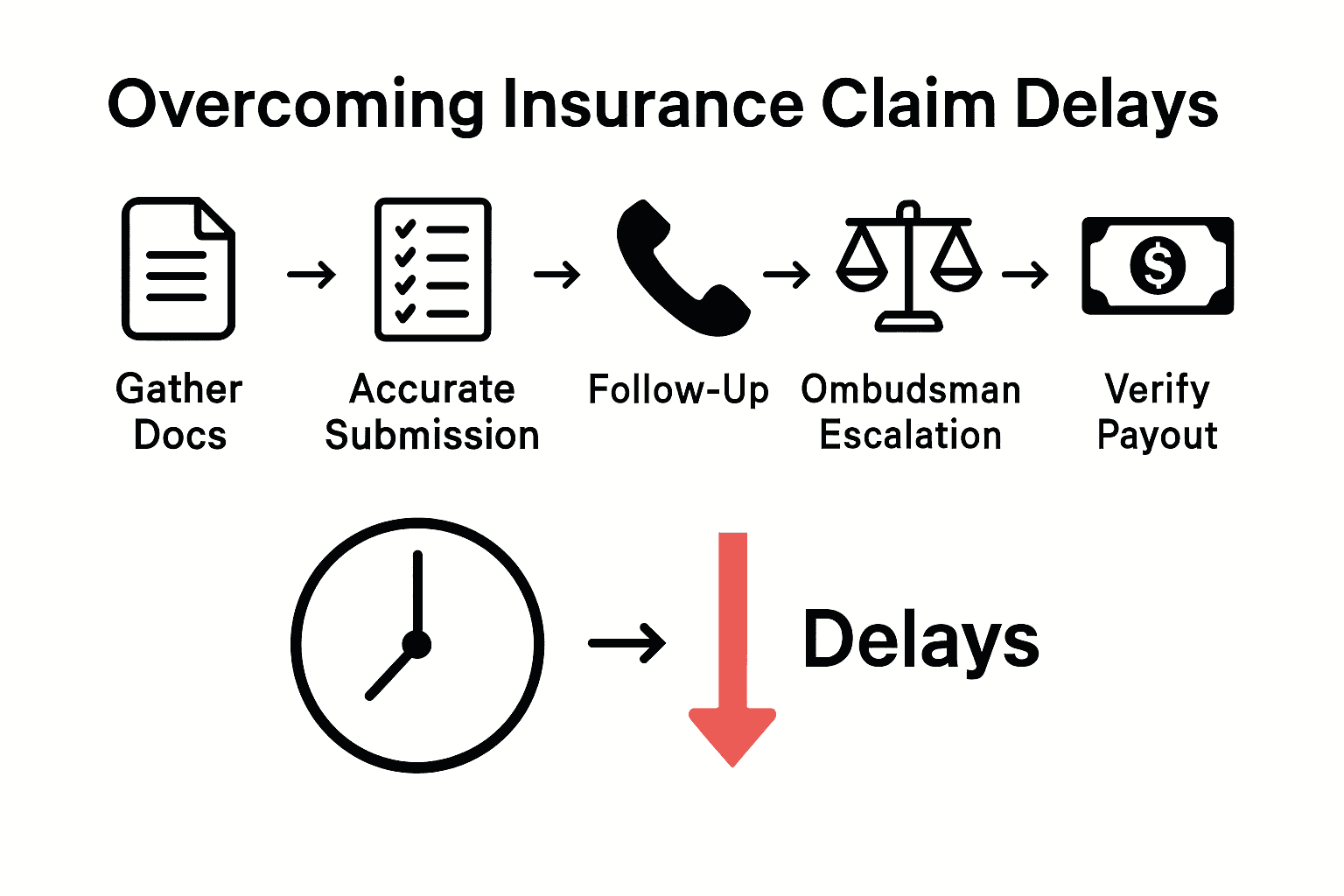
| 1. Gather documentation promptly | Collect all necessary documents immediately to ensure a smooth claims process and avoid legal issues. |
| 2. Submit your claim accurately | Fill out the claim form carefully, ensuring all personal details and supporting documents are precise and complete. |
| 3. Follow up consistently with your insurer | Maintain regular communication to prevent delays; document all interactions for clarity and accountability. |
| 4. Escalate unresolved issues to ombudsman | If your claim stalls, gather all documentation to escalate to the ombudsman for resolution assistance. |
| 5. Verify your payout details | After approval, confirm settlement amounts and payment methods to avoid banking errors and administrative issues. |
Table of Contents
- Step 1: Gather All Required Documentation Immediately
- Step 2: Submit Your Insurance Claim Accurately
- Step 3: Follow Up Consistently With Your Insurer
- Step 4: Escalate Unresolved Delays To Ombudsman
- Step 5: Verify And Confirm Your Payout Details
Step 1: Gather all required documentation immediately
Getting your insurance claim processed quickly starts with being proactive about documentation. Think of this step as your claims fast track—the more organized and thorough you are upfront, the smoother your entire claims journey will be.
Start by creating a comprehensive document checklist. According to research from South African insurance regulations, you must provide documents and information “as soon as reasonably practicable” to avoid potential legal complications. This means gathering everything from incident reports to proof of ownership right at the beginning.
Your documentation package should typically include:
Here’s a summary of the essential documents you should prepare:
| Document Type | When Required | Purpose |
|---|---|---|
| Police Report | After theft or crime incidents | Official incident verification |
| Incident Photographs | For all claims involving damage | Visual proof of loss/damage |
| Proof of Ownership | For claimed/damaged items | Confirms you own affected assets |
| Medical Reports | For personal injury claims | Evidence of injury and treatment |
| Repair Estimates/Invoices | For property or vehicle repairs | Illustrates cost of damages/repairs |
| Insurance Policy Document | For all claim types | Reference contract terms and cover |
- Original police reports (if applicable)
- Incident photographs
- Proof of ownership for damaged items
- Medical reports (for injury claims)
- Repair estimates or invoices
- Your original insurance policy document
Pro Tip: Make digital copies of everything. Scan documents or take clear photographs as backup in case original papers get misplaced.
Remember that while insurers must help you through this process, the initial responsibility of documentation falls squarely on your shoulders. As research from the Long-term Insurance Ombudsman indicates, although insurers must obtain supporting evidence for exclusions, you still need to provide core documentation promptly.
Quick preparation prevents potential claim delays.
 The more complete your initial submission, the faster your insurance provider can process your claim and get you the support you need.
Step 2: Submit your insurance claim accurately
Now that you have gathered your documentation, it is time to submit your insurance claim with precision. Accuracy is your best friend in this process. According to research, over 30% of insurance claims in South Africa are delayed or rejected due to missing documentation or process errors.
Begin by carefully filling out the claim form. Read every section thoroughly and answer questions with clear, concise information. Do not guess or provide vague responses. Each detail matters.
When submitting your claim, follow these key guidelines:
- Double check all personal information
- Provide exact dates and times of incidents
- Include comprehensive incident descriptions
- Attach all supporting documentation
- Verify the completeness of your submission
Pro Tip: Always keep copies of everything you submit for your personal records.
According to legal principles of good faith, insurers must promptly investigate claims when you provide accurate information. This means your careful attention to detail can significantly speed up your claim processing.
Read our comprehensive guide on insurance claim processes to ensure you do not miss any crucial steps. Being methodical now can save you weeks of potential back and forth with your insurance provider.
Remember that transparency and accuracy are your strongest allies in getting your claim processed quickly and efficiently.
Step 3: Follow up consistently with your insurer
Your insurance claim is not a set-it-and-forget-it situation. Following up consistently is your secret weapon to preventing unnecessary delays and keeping your claim moving forward. Research shows that proactive communication can dramatically speed up claim resolution.
Start by establishing a regular communication schedule. Keep a detailed log of every interaction including dates, names of representatives you spoke with, and key discussion points. Your goal is to create a paper trail that demonstrates your commitment to resolving the claim.
Your follow-up strategy should include:
- Weekly phone calls to your claims representative
- Email documentation of every conversation
- Polite but firm requests for status updates
- Tracking response times
- Escalating to management if no progress occurs
Pro Tip: Always remain professional and document everything in writing.
According to legal experts, insurers are obligated to provide updates about claim delays. One compelling case study revealed a claim that was stalled for a year suddenly resolved within a month after persistent follow-up correspondence.
Learn more about tracking your insurance claim status to ensure you are equipped with the right tools and knowledge.
Consistent follow-up transforms you from a passive claimant into an active participant in your claim resolution process.
 Your persistence can make all the difference between a delayed claim and a swift settlement.
Step 4: Escalate unresolved delays to ombudsman
If your insurance claim seems stuck in limbo and your insurer is not responding effectively, it is time to bring in the big guns. The ombudsman is your neutral referee in insurance claim disputes who can help push your claim across the finish line.
In South Africa, you have two primary ombudsman routes depending on your insurance type. For short-term insurance claims, the Ombudsman for Short-term Insurance (OSTI) is your go-to resource. According to the National Forum of Insurance Ombud Schemes, you can file a free complaint if no resolution has been received within about 30 days of your initial claim.
Before escalating, ensure you have:
- Comprehensive documentation of all claim interactions
- Copies of original claim submission
- Detailed timeline of communication attempts
- Evidence supporting your claim
- Reference numbers from previous correspondence
Pro Tip: Keep communication professional and fact-based when presenting your case to the ombudsman.
According to insurance regulations, you should first exhaust the insurer’s internal complaint process—typically a six-week window—before approaching the ombudsman. This demonstrates you have made reasonable attempts to resolve the issue internally.
Check our guide on insurance claim resolution processes to understand the full escalation pathway.
Remember that the ombudsman service is free and designed to protect consumers. Your persistence can turn a seemingly hopeless claim into a resolved settlement.
Step 5: Verify and confirm your payout details
Congratulations. You are now approaching the final stage of your insurance claim journey. Verifying your payout details ensures you receive exactly what you are entitled to and prevents potential banking or administrative complications.
Once your claim is approved, the insurer will provide a detailed breakdown of the settlement. Carefully review every line item to confirm the amounts match your expectations and original claim documentation. According to South African insurance processes, understanding expected timelines and bank processing durations helps manage expectations effectively.
Check these critical elements during payout verification:
- Exact settlement amount
- Breakdown of covered expenses
- Payment method details
- Expected deposit date
- Reference numbers for the transaction
- Tax implications if applicable
Pro Tip: Request a written confirmation of the payout details for your personal records.
Contact your insurance representative immediately if any discrepancies appear. Do not assume everything is correct just because the claim has been approved.
Understand more about insurance payouts in our detailed guide to ensure you are fully informed throughout the process.
Remember that being proactive and detail-oriented can prevent future complications and ensure a smooth final settlement of your insurance claim.
Tired of Insurance Claim Delays? Discover a Hassle-Free Solution
Claim delays drain your time and patience. Waiting for payouts, chasing paperwork, and uncertainty around your documentation can feel overwhelming. This article shows you every step to overcome these challenges by prioritising your documents, submitting accurate information, staying proactive with your insurer, and understanding escalation routes. Even if you follow each strategy, you may worry that your insurer is not on your side or the process is just too drawn out.
With King Price Insurance, you can take back control. We offer tips, guides, and lightning-fast support for all aspects of your policy, including car, home, contents, and even cellphone insurance. Our dedicated service teams understand the urgency of your payout and help you avoid stressful delays. Looking for instant answers about claim progress, documentation, or payout status? Visit our King Price Insurance home page and explore practical info tailored to South African needs. Ready to finally put an end to slow, stressful claims? Click through now to connect with an insurer who champions your financial peace of mind.
Frequently Asked Questions
How can I gather the required documentation for my insurance claim?
Start by creating a comprehensive checklist of documents needed for your claim, including police reports, incident photographs, and proof of ownership. Make sure to gather these documents as soon as possible to avoid delays.
What should I include when submitting my insurance claim?
Ensure that your claim submission includes accurate personal information, detailed descriptions of the incident, and all supporting documents. Review everything carefully to minimize errors that could delay your claim processing.
How often should I follow up with my insurance provider after submitting a claim?
Establish a regular communication schedule, ideally calling your claims representative weekly. Consistent follow-up can help keep your claim moving forward and reduce potential delays.
When should I escalate an unresolved insurance claim to the ombudsman?
Consider escalating your claim if you have not received a resolution after exhausting your insurer’s internal complaint process, typically within six weeks. Ensure you have a thorough record of all communications and previous correspondence before reaching out to the ombudsman.
What details should I verify once my insurance claim is approved?
Review the settlement amount, breakdown of covered expenses, and payment method. Confirm these details as soon as possible to prevent any banking or administrative complications that could delay your payout.